Posts

A Brief Journey Through Web Services - SOAP, REST, and Beyond

Introduction In this post, we’ll dive deep into the fascinating evolution of web services—from their early SOAP-based beginnings, through the rise of WebDAV and REST, and all the way to modern solutions like GraphQL and gRPC. Each approach addressed a particular set of challenges, and all of them left a lasting mark on the way applications talk to each other over the Internet. Let’s explore how web services went from clunky XML exchanges to streamlined JSON endpoints to high-performance, real-time systems. Regardless of whether you are a seasoned developer or just starting your journey, understanding these historical shifts will give you valuable insights into the “why” behind today’s popular API styles. Early Days with SOAP and RPC-Focused Services The Advent of Simple Object Access Protocol (SOAP) In the late 1990s, Simple Object Access Protocol (SOAP) emerged as a game-changer for exchanging data across different platforms. It mainly ran over HTTP (though it wasn’t strictly li...

Dynamic Traits with Java

Traits are reusable components representing a set of methods or behaviors that can be used to extend the functionality of multiple classes. Some programming languages like Groovy and Scala have been supporting Traits for a long time, and allow dynamic association of Traits to any object, at runtime. Java being a strongly typed programming language, enforces a very strict discipline of type association, upfront whilst declaring any language element, e.g. variables, functions, etc; and the same is applicable for Classes too. Therefore when you implement a class in Java, the associative types for the class, must be specified as a part of the declaration of the class, which strongly binds the type interfaces to the class, and cannot be changed in runtime. The concept of Traits is implemented in Java using Interfaces, which contain default methods and variables to allow maintaining an object's state. However, these interfaces then have to be tightly coupled with the class decl...

Java 7, brings a simple yet a long awaited feature...

Would you be surprised to know that the API of java.io.File only supported getting the last modified time, and NOT the file's creation time, until Java 7...? Well, not many people seem to be aware of this and surprisingly even the Internet was very quiet on this topic all the while. So if you are using anything below Java 7 and are desperate to fetch a file's creation time then, one solution would be to write some native code to call system routines and then call the native code using JNI. Most of this work seems to be already done for you in a library called JNA , though. Nevertheless, you will still need to do a little OS specific coding in Java for this, though, as you'll probably not find the same system calls available in Windows and Unix/Linux/BSD/OS X.

VMWare Cloud Foundry - Developing "cloud-ready" web applications has never been so easy

A lot has been said and done about services on the cloud lately and "Platform as a Service" (PaaS) is probably one of the most popular buzz-word that's been around for quite sometime now. However, I sincerely feel that the common man (read as "developer") is yet to get a taste of what it really means. Now, this very paradigm seems to be soon changing, with VMWare Cloud Foundry. Cloud Foundry is the world’s very first open Platform as a Service (PaaS). It is designed to help developers easily create web applications, using multiple programming frameworks including Spring for Java, Ruby on Rails and Sinatra for Ruby; that can run upon public and private cloud environments, with just about no additional learning curve. So, by now if you are dreaming of a possibility to port your existing web-applications to the cloud with minimal efforts, then let me give you the good news - "it's all possible here..." Well, looks like i've done a lot of sales t...

Demystifying Enterprise Architecture with TOGAF - Understanding the Architecture Development Methodology (ADM)

In the previous article, we glanced through Enterprise Architecture as a whole and also discussed the need for an Enterprise Architecture Framework, like TOGAF. With this article we shall continue exploring TOGAF further, and discusses TOGAF's Architecture Development Methodology (ADM). The Architecture Development Methodology (ADM) The Architecture Development Methodology (ADM) provides a proven and repeatable process for developing architectures. The Scope The scope of ADM includes or encompasses the below listed activities, which are generally carried out in iterative cycles of continuous architecture definition and realization; thus aiding a controlled transformation of an enterprises in response to business goals and opportunities - Establishing an architecture framework Developing architecture content Transitioning Governing the realization of architectures Implementation Phases The implementation of ADM could be envisioned across the following phases - Preliminary Initiation...

Demystifying Enterprise Architecture with TOGAF

Lately I've been studying/reading The Open Group Architecture Framework (TOGAF), and I simply could not resist from appreciating the structural approach that it introduces towards envisioning and capturing Enterprise Architecture. I therefore thought of initiating a series of articles herein, with the sole purpose of sharing, simplifying and promoting the framework especially amongst the architecture aspirants out there who follow and read my blog. This write-up, which is the first one in the series, intends to provide a brief overview on Enterprise Architecture and then further goes on to illustrate the need for an Enterprise Architecture Framework. Preface ISO/IEC 42010: 2007 defines "architecture" as: "The fundamental organization of a system, embodied in its components, their relationships to each other and the environment, and the principles governing its design and evolution." TOGAF embraces but does not strictly adhere to ISO/IEC 42010: 2007 terminology. ...

Easy 3D with WebGL and Three.js

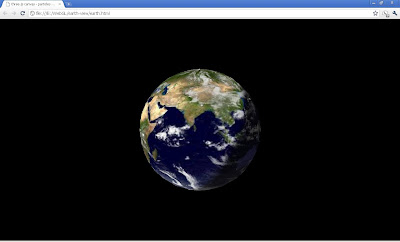
Lately a lot has been happening in 3D around the world. From movies to electronic gadgets like televisions, projectors and gaming consoles, everything seems to be heading toward rendering that additional 3rd dimension. A 3D experience in itself so very enticing that one would just falling it love with it; and thus the creative ones amongst us are constantly thinking about various areas wherein it could be applied. Some of the obvious areas of application would be bio-technology, clinical research, engineering drawings and entertainment media; but meanwhile some creative minds amongst us have gone ahead thinking differently and even made simple software applications that we use in our everyday lives, to render a user interface with 3D. For instance, a few months ago I came across a program called 3DNA Desktop which improves the way we work with Windows and the Web. With 3DNA Desktop one can choose from different 3D worlds to explore and customize the same, to create an immersive and ...

Table2Visualization : Rendering Google Visualization Charts with HTML Tables

With the advent of the analytics age, one would find applications spring-up every month that lets you track, monitor, and analyze just about anything, from human habits to system behaviors. Such applications generally have a standard implementation pattern wherein they primarily collect, upload, process, and display data. Now, somebody trying to develop one such application would obviously face challenges, of different kinds, at each of these points depending upon the domain of applicability. However, the challenges in displaying the data, in a way that it is understandable to non-professionals, are the same for all of them. Oftentimes, we rely upon statistical charts and graphs to render such data. These days one would find a plenty of charting libraries that make this possible easily (and some of them without any cost), for example Visualize, MooCharts, ProtoChart etc. One such player in the world of data visualization is Google itself. Google Visualization is a set of JavaScript lib...

GMail does not understand dots...

I recently discovered some little-known ways to use a GMail address that can give you greater control over your inbox and save you some time. Actually, when you choose a Gmail address, you actually get more than just "yourusername@gmail.com"; here are two different ways you can modify your Gmail address and still continue getting your mails: Append a plus ("+") sign and any combination of words or numbers after your email address. For example, if your name was yourusername @gmail.com, you could send mail to yourusername +friends@gmail.com or yourusername +mailinglists@gmail.com. Insert one or several dots (".") anywhere in your email address. Gmail doesn't recognize periods as characters in addresses -- Google mail just ignores them. For example, you could tell people your address was hikingfan@gmail.com, hiking.fan@gmail.com or hi.kin.g.fan@gmail.com. For me, the real value in being able to manipulate your email address is that it makes it really easy...

Simple Serialization

The Simple XML serialization framework has released version 1.2. Simple is a serialization framework for Java that intends to provide an XML serialization framework that requires no configuration or mappings to serialize objects bi-directionally; i.e. to and from standard XML. Below is a list of some of the capabilities of the framework. Simple framework with powerful capabilities The framework used to provide XML serialization is simple to use and revolves around several annotations an a single persister object used to read and write objects to and from XML. Both serialization and deserialization are fully supported. It requires absolutely no configuration Unlike many of the XML frameworks for Java there are no mappings or configuration required to serialize objects regardless of its complexity, not even code to establish mappings. Everything is done at runtime, only annotations are required to perform the object to XML structure. The XML schema is represented using field and method a...

Is Java String really immutable...?

In many texts String is cited as the ultimate benchmark of Java's various immutable classes. Well, I'm sure you'd have to think the other way once you have read this article. To start with, let's get back to the books and read the definition of immutability. The Wikipedia defines it as follows - 'In object-oriented and functional programming, an immutable object is an object whose state cannot be modified after it is created.' I personally find this definition good as it mentions that an immutable instance's state should not be allowed to be modified after it's construction. Now keeping this in the back of our minds, let's decompile Java's standard String implementation and peep into the hashCode() method - public int hashCode() { int h = hash; if (h == 0) { int off = offset; char val[] = value; int len = count; for (int i = 0; i h = 31*h + val[off++]; } hash = h; } return h; } A detailed ...

Schematron - validating web-forms and java objects

Whilst developing web applications, more than often we are confronted with the need to validate user inputs. On the client-side (browsers) we generally do that with scripting languages; and for those users who have perhaps deliberately disabled their browser script support; we perform the same set validation on the server side, and this time we write some lines-of-code to extract the user input from the HTTP request and validate the same. Well, although ironic; yet it seems to be a de-facto that - we have to specify the validation rules separately on the client and server side, for eventually validating something that is semantically same. A technical analysis into the core reason reveals that – although the semantics of the herein discussed "thing" (i.e. the user input) are the same, yet the representations of the semantic on the client and server side are different; which enforces us to implement the extraction and validation logic differently. So going by that theory - if ...

Introducing Schematron

Schematron is a rule-based validation language for making assertions about patterns found in XML documents. It is a simple language which is based very much on XML itself and uses standard XPath to specify the assertion statements. The Schematron definations (a.k.a Schema) can be processed with standard XSL templates; which makes Schematron applicable is a variety of scenarios. Although a Schematron defination is referred as a Schema, but one must understand that Schematron differs in the basic concept from other schema languages; i.e. it is not based on grammars but on finding tree patterns in the parsed document. This approach allows many kinds of structures to be represented which could be difficult with grammar-based schema languages. For instance - imagine how would a typical schema be, for the following XML document - <?xml version="1.0" encoding="UTF-8"?> <instance> #### <person> ######## <fname/> ######## <lname/> #### </pers...

Scarlet – A Scala DSL for web applications

Work in Progress The Scarlet project is currently under development. Please keep an eye on the sourceforge project site (sourceforge.net/projects/scarlets) or contact personally for updates. Introduction to Domain Specific Language (DSL) Domain-specific languages have lately become a hot topic and a lot is being spoken and written about them all over the internet; much of the buzz around functional languages is their applicability to (once again) put the power and control of an application in exactly the right place where it belongs, i.e. in the hands of its users. By defining a simple language that the application users can understand, feel comfortable to communicate and use, programmers can effectively reduce their involvement in the never-ending cycle of UI requests and enhancements and can let users create scripts and other tools that allow them to create newer behavior in the applications they use. A perfect example of a wildly successful DSL is the Microsoft® Office Excel ...

Web4J : An Interesting framework

Its been quite a while since my last post here. I understand that my sudden disappearing act must have annoyed a many of my regular visitors; especially the ones who are expecting the second part of the XRX tutorial. Whilst you wait for the concluding part of the XRX article, I thought of sharing somethings that i found to be interesting - As Java Web application frameworks have become more powerful and flexible, they've also become more complex. John O'Hanley's WEB4J framework in many ways flies in the face of this trend: it offers few customization options, but is easy to learn and work with. Read on to learn about the unusual (and somewhat contrarian) development principles behind WEB4J. You'll also have the opportunity to test out the framework by building a feature for a sample Web application... [ more ]

Part I : XRX Architecture - Unleashed

During my tenure at Software AG, I was introduced to the power of XML. To my candor, i was very impressed to see the wide range of problems that XML promised to solve. Especially, to mention the performance power-punch that XML databases unleash when combined with XQuery and REST. A couple of years later, I moved into the consultancy world. Being back in the consultancy world and seeing business systems with my renewed XML-ized eyes (all credits to Software AG Tamino API and tools laboratory), I was highly dismayed to find that business oriented systems seldom use the real power of XML. The usage of XML herein has been more-so confined to defining application configurations and bare minimum transformation to either render interface elements or reports. I agree, there have been a few exceptions to this statement too. After spending quite some years revolting the general underutilization of XML; apparently I found my preferred architecture – i.e. XRX (XForms/REST/XQuery). What is so u...

NLBean - Make your database understand English

Natural language processing (a.k.a. NLP) is a stream of artificial intelligence and computational linguistics. In theory, it is the most attractive method of human-computer interaction; but as natural language recognition seems to require extensive knowledge about the outside world and the ability to manipulate it, implementing Natural Language Processing has infact been one of the most sought after conundrums in the computing world. This article presents an abstract introduction to natural language processing and further discusses implementing the same to query databases. What is a Natural Language Processing (NLP)…? Natural language processing is the collection of techniques employed to enable the computers to understand the languages spoken by humans. The concept linguistic analysis and processing originated with efforts in the United States in the 1950s, wherein the intent was to use computers to automatically translate texts from foreign languages into English. Since compute...